Google has officially pre-announced its December 2026 Core Update, giving website owners an early look at upcoming changes to Google Search. The announcement came on November 24, 2026, just hours after Google confirmed that the November 2026 Core Update had finished rolling out.
This upcoming update focuses on two important areas: improving how Google's systems understand and rank relevant content, especially for longer and more complex search queries, and improving personalized search results for users who have personalization turned on.
Unlike previous core updates that were generally announced when their rollouts began, Google has provided advance notice this time. The company has confirmed that the update is scheduled for December 2026, although an exact launch date and rollout duration have not yet been announced.
For website owners, SEO professionals, and digital marketers, this is a good opportunity to review existing content, evaluate recent ranking changes, and prepare for the next round of search updates.
Google December 2026 Core Update: Key Details
Here are the important details confirmed by Google's Search Status Dashboard.
Detail | Information |
|---|---|
Update name | December 2026 Core Update |
Announcement date | November 24, 2026 |
Expected release | December 2026 |
Exact rollout date | Not announced |
Rollout duration | Not announced |
Update type | Broad core ranking update |
Main focus | Understanding and ranking relevant content |
Additional focus | Longer and more complex search queries |
Personalization | Improvements for users with personalization enabled |
Geographic scope | All locations |
Language coverage | All languages supported by Google Search |
Official source | Google Search Status Dashboard |
Google confirmed that the update will improve how its systems understand and rank relevant content, including content related to longer and more complex questions. It will also improve personalized results for people who have personalization turned on.
The announcement does not provide a list of specific ranking signals or technical requirements. Website owners should therefore focus on Google's existing guidance for creating helpful, reliable, people-first content.
November 2026 Google Core Update: A Quick Recap
Before preparing for the upcoming December update, it is important to understand what happened during November.
Google began rolling out the November 2026 Core Update on November 10, 2026, at 10:06 a.m. Pacific Time. The update applied globally and across all languages supported by Google Search.
On November 24, Google officially confirmed that the rollout was complete.
The update lasted approximately 13 days and 20 hours, according to Google's Search Status Dashboard.
November 2026 Core Update Timeline
Event | Date |
|---|---|
Rollout started | November 10, 2026 |
First major industry observations | November 13, 2026 |
Rollout completed | November 24, 2026 |
December update pre-announced | November 24, 2026 |
During the rollout, SEO professionals reported ranking fluctuations across different websites and industries. Some websites experienced visibility declines, while others reported improvements.
Industry observations also highlighted concerns about large collections of repetitive, programmatically generated pages and content that was not closely connected to a website's main business.
However, Google did not publish a specific list of ranking factors responsible for these movements. These observations should be treated as industry analysis rather than confirmed changes to Google's algorithm.
What Website Owners Should Learn From November
The November update reinforces the importance of evaluating website performance instead of making immediate changes whenever rankings fluctuate.
A decline in organic traffic does not automatically mean that a website has received a penalty. Core updates reassess how Google's systems evaluate content and rank relevant pages.
Website owners should examine affected pages, compare their content with competing results, and identify opportunities to provide more useful information.
For a more detailed breakdown, read our previous guide: Google November 2026 Core Update: What Changed and What Website Owners Should Do.
What Makes the December 2026 Core Update Different?
The biggest difference is that Google has announced the upcoming update before its rollout begins.
Google's November update was announced when the rollout started. However, the December update was announced on November 24, giving website owners advance notice of the upcoming changes.
There are two officially confirmed focus areas.
1. Better Understanding of Longer and More Complex Search Queries
Google wants to improve how its systems understand and rank relevant content for longer and more complex questions.
People do not always search using short keywords. Many searches contain multiple requirements, specific situations, comparisons, or detailed questions.
For example, someone might search for:
- Best CRM software for a small business with a limited budget
- How to choose an SEO agency for a local service business
- Website redesign cost for an established ecommerce company
- Best digital marketing strategy for generating local business leads
These searches communicate more information than a short keyword.
Google's announcement suggests that understanding this type of search intent is an important part of the December update.
What this means for website content
Website owners should review whether their pages provide enough information to address the complete needs behind a search query.
Instead of creating multiple thin pages around slightly different keyword variations, focus on providing meaningful information that covers the subject properly.
For example, an article about website redesign should not only explain what a redesign means. It can also cover planning, costs, design considerations, development, SEO implications, and common mistakes.
The goal is to provide a complete and useful resource rather than simply increasing the number of keywords included on a page.
2. Improvements to Personalized Search Results
The second confirmed focus is improving personalized results for people who have personalization turned on.
Personalization allows Google to consider relevant user preferences and activity when presenting search results.
This means that search experiences may differ depending on whether personalization is enabled and which preferences are available to Google's systems.
For website owners, this makes search visibility an important metric to evaluate carefully.
A website might appear differently across search experiences, locations, and user contexts. A single manual Google search should not be treated as a complete measurement of organic performance.
What website owners should consider
- Monitor organic performance over time instead of relying on individual searches.
- Review search queries and landing pages in Google Search Console.
- Pay attention to the relevance of content for different search intents.
- Build strong brand recognition and provide consistent information across the website.
- Evaluate organic traffic, engagement, and conversions together.
Google has not explained exactly how personalization improvements will work or which signals will be involved. Therefore, website owners should avoid assuming that a particular optimization technique will guarantee better personalized rankings.
Why Did Google Pre-Announce the December 2026 Core Update?
The advance announcement is one of the most interesting developments surrounding this update.
Google has traditionally announced major core updates when they begin rolling out. This time, the company published a notice on November 24, confirming that another core update is scheduled for December.
Google's new guidance on staying informed about Search ranking updates explains that advance notices may be provided for significant ranking changes that could affect many queries and websites.
It also describes notices for policy changes that may require website owners to take action.
The new announcement process is connected to Google's broader transparency around Search ranking changes, including notice requirements relating to the UK's Competition and Markets Authority (CMA).
However, Google has not explicitly stated that the CMA requirements were the direct reason for this particular announcement.
What the Advance Notice Means for SEO Professionals
The announcement gives SEO teams an opportunity to prepare before the next rollout begins.
Instead of waiting until rankings change, website owners can:
- Review the results of the November update.
- Record current keyword rankings and organic traffic.
- Identify important pages that need content improvements.
- Review website quality and technical SEO.
- Establish a performance baseline for December.
This preparation will make it easier to understand the impact of the upcoming update once Google begins rolling it out.
How the December 2026 Core Update May Affect Website Rankings
Google has confirmed the update's general focus, but it has not provided a detailed explanation of how individual websites or industries will be affected.
However, its stated focus gives website owners several areas worth reviewing.
Websites With Thin or Incomplete Content
Pages that provide little useful information may struggle to satisfy complex search intent.
For example, a service page that only describes a service in a few generic sentences may not answer the questions a potential customer has before making a decision.
Adding meaningful service details, relevant examples, useful explanations, and clear information can make the page more helpful.
Websites Targeting Multiple Search Intents
Some websites create separate pages for every small keyword variation, even when the search intent is almost identical.
This can result in repetitive content that provides little additional value.
Review your website structure and identify pages that overlap in purpose. Where appropriate, consolidate similar content and make each important page more useful and distinct.
Websites With Strong Topical Relevance
A website that consistently publishes useful information within its subject area can provide visitors with a more complete resource.
For example, a digital marketing website can cover SEO, local SEO, Google Ads, content marketing, website optimization, and related topics with appropriate depth.
The important point is that every article should serve a clear audience need and connect naturally with the website's main services.
Topical coverage alone does not guarantee higher rankings, but useful and relevant content helps visitors understand the subject and make informed decisions.
Websites Relying on Individual Keyword Rankings
Search visibility is not limited to one keyword or one search result.
With the upcoming improvements to complex queries and personalized results, website owners should evaluate broader performance patterns.
Look at the queries bringing visitors to your website, the pages receiving impressions, and the conversions generated through organic search.
This provides a more complete understanding of SEO performance than checking a handful of keywords manually.
How to Prepare Your Website for the December 2026 Google Core Update
Although Google has not published any special preparation requirements, website owners can use its existing core update guidance to review their websites.
Here are practical steps to take before the rollout.
1. Review Your Existing Website Content
Start by identifying the most important pages on your website.
Review service pages, product pages, landing pages, and existing blog articles.
Check whether each page provides useful information, matches its intended search intent, and answers the questions visitors are likely to have.
Update outdated information and improve sections that lack sufficient detail.
Avoid rewriting content simply to make pages longer.
2. Focus on Search Intent and Content Relevance
A page should address the reason someone searches for a particular keyword.
For example, someone searching for SEO services may want to understand available services, pricing considerations, benefits, and how to select an agency.
A page that only repeats the phrase SEO services without addressing these needs may not provide enough value.
Organize your content around the information visitors actually need.
3. Improve Content Depth and Original Value
Review whether your content provides information that readers can genuinely use.
Consider including:
- Practical examples and relevant explanations.
- Original insights based on experience.
- Accurate facts and supporting references.
- Clear comparisons where appropriate.
- Useful steps and actionable recommendations.
- Updated information when circumstances change.
Avoid publishing multiple articles that repeat the same information with slightly different wording.
4. Review Internal Linking
Internal links help visitors discover related information and navigate your website.
They also help search engines understand the relationship between different pages.
Link relevant blog articles to related service pages and connect supporting articles with important topic guides.
Use descriptive anchor text and ensure every link is relevant to the surrounding content.
5. Check Technical SEO Issues
Content quality is important, but website accessibility and technical health also matter.
Review your website for:
- Broken internal links.
- Incorrect canonical tags.
- Unnecessary redirect chains.
- Indexing problems.
- XML sitemap errors.
- Mobile usability issues.
- Slow-loading pages.
- Important pages blocked from crawling.
Use Google Search Console to identify indexing and performance issues that need attention.
Do not assume that fixing every technical issue will automatically improve rankings. Technical SEO helps search engines access and understand your website, while content relevance and overall quality remain important considerations.
6. Establish a Google Search Console Baseline
Before the December update begins, record your current organic search performance.
In Google Search Console, review:
- Total clicks and impressions.
- Average position.
- Important search queries.
- Top-performing landing pages.
- Pages experiencing recent declines.
- Country and device performance.
Export the data so you can compare it with performance after the update.
This will help distinguish normal fluctuations from more significant ranking changes.
7. Avoid Unnecessary Changes to High-Performing Pages
Do not make major changes to pages that are already performing well without a clear reason.
Review their accuracy, usefulness, and relevance first.
Google's core update documentation specifically recommends avoiding unnecessary changes to content that is already performing well.
Focus on genuine improvements rather than making changes simply because another update is approaching.
How to Monitor the December 2026 Core Update
Once Google confirms that the rollout has started, monitor your website regularly.
However, avoid drawing conclusions from the first few days of ranking fluctuations.
Use the following approach:
Before the rollout
- Export Google Search Console performance data.
- Record important keyword rankings.
- Identify your highest-value landing pages.
- Review organic leads and conversions.
- Document any recent website changes.
During the rollout
- Monitor clicks, impressions, and average positions.
- Watch for significant changes across important pages.
- Check Google's Search Status Dashboard.
- Avoid reacting to temporary ranking movements.
- Record changes without making unnecessary updates.
After the rollout
Google recommends waiting at least one full week after a core update finishes before analyzing its impact in Search Console.
Compare a week of post-update data with a week before the rollout began.
Review the most affected pages and queries, and investigate whether the changes are small or significant.
For major and sustained declines, conduct a deeper content and website-wide quality assessment before deciding what to improve.
December 2026 Core Update vs. November 2026 Core Update
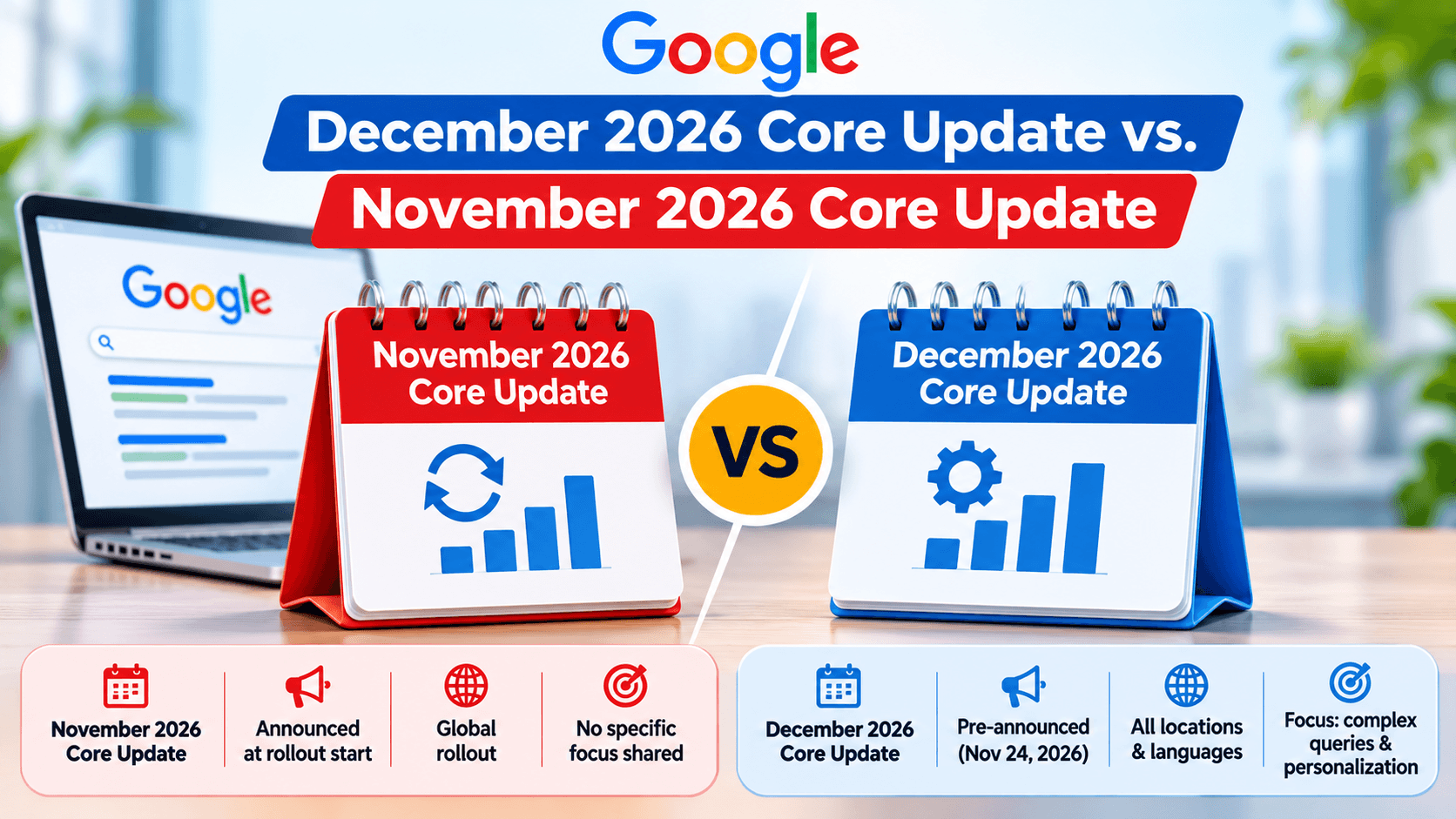
The two updates have different announcement approaches and stated focus areas.
Comparison | November 2026 Update | December 2026 Update |
|---|---|---|
Announcement | November 10, 2026 | November 24, 2026 |
Announcement timing | At rollout start | Before rollout |
Rollout date | November 10–24 | Scheduled for December |
Duration | 13 days, 20 hours | Not announced |
Stated focus | No specific focus published | Complex queries and personalization |
Geographic coverage | Global | All Search locations |
Language coverage | All languages | All supported languages |
The most important distinction is that Google has provided more information about the intended focus of the December update before its launch.
However, both updates fall under Google's broader core update process, and its existing guidance remains relevant.
Final Thoughts
Google's pre-announcement of the December 2026 Core Update gives website owners an opportunity to prepare before the next major ranking change.
The upcoming update places particular attention on understanding complex search queries and improving personalized results. While Google has not explained the technical details behind these changes, its existing guidance continues to emphasize helpful, reliable, people-first content.
Website owners should use the time before the rollout to review their content, improve the overall website experience, monitor organic performance, and establish a clear SEO baseline.
Most importantly, avoid making unnecessary changes based on speculation. Focus on providing useful information, satisfying search intent, and building a website that genuinely serves its audience.
For the latest confirmed information, follow Google's Search Status Dashboard and official core update documentation.
Share this article