Your homepage is the digital front door to your business and in 2025, that door needs to open fast, look stunning, and guide visitors effortlessly toward taking action. A modern homepage design is more than just eye-catching visuals; it’s a strategic blend of design psychology, usability, and conversion science.
In this blog, you’ll discover 12 modern homepage design examples that convert, along with actionable insights you can apply to your own website to attract and convert more visitors.
What Makes a Homepage Design “Modern”
A truly modern homepage isn’t defined by the latest color palette or typography trend — it’s about creating an experience that’s visually appealing, fast, and conversion-focused. Below are the key elements that define a modern, high-performing homepage in 2025.
Minimalism with Purpose
Modern web design thrives on clarity. Clean layouts, balanced whitespace, and focused content help visitors navigate easily without distractions. The goal is to guide users’ attention toward your primary call-to-action (CTA) while maintaining a sleek aesthetic.
Mobile-First Responsiveness
With most web traffic coming from mobile devices, your homepage should look and perform beautifully on every screen. Google prioritizes mobile-first indexing, so responsiveness isn’t just about user experience — it’s a direct ranking factor.
Fast Loading and Technical Optimization
A slow homepage can ruin a first impression instantly. Modern sites use optimized images, lightweight code, and caching tools to maintain top speeds. For better insights, test your website’s performance using Google PageSpeed Insights.
Typography and Visual Hierarchy
Typography is a subtle yet powerful design element. Use clean, modern fonts with clear spacing and consistent sizing to ensure readability. Well-defined heading structures (H1, H2, H3) help users and search engines understand your content flow.
Conversion-Focused CTAs
Each homepage section should have a clear purpose and a well-placed CTA. Whether that’s booking a consultation, exploring services, or viewing your portfolio.
Authentic Imagery and Branding
Real images and consistent branding build trust faster than generic stock photos ever could. Authentic design communicates credibility and personality.
Pro Tip:A modern homepage is not about trends — it’s about functionality meeting emotion. Your design should speak to your audience’s needs, load fast, and inspire trust at every scroll.
12 Modern Homepage Design Examples That Convert
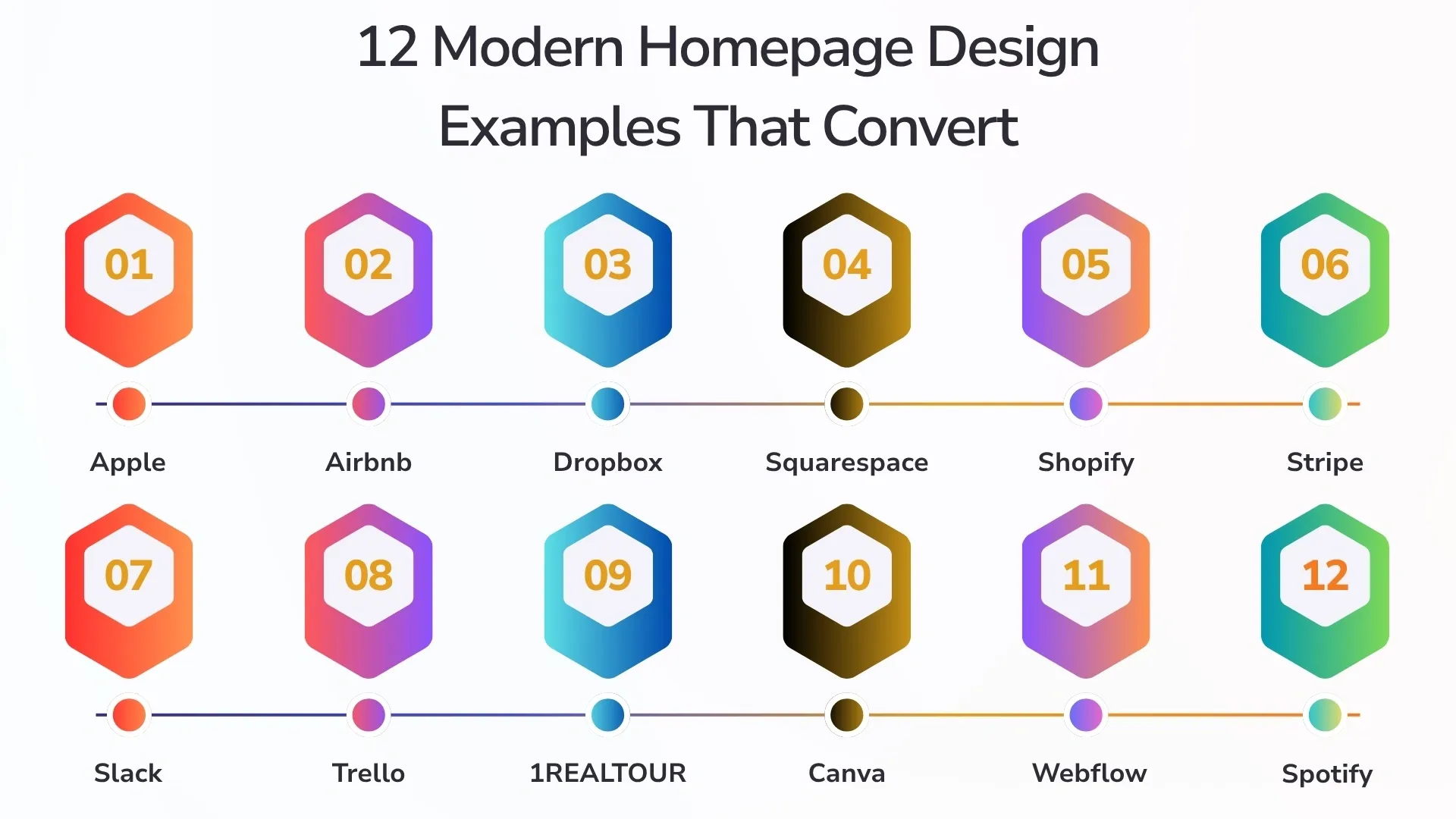
Modern homepage design goes far beyond surface-level beauty. It’s about guiding visitors toward trust, clarity, and action. Below are 12 inspiring homepage design examples that prove how great visuals, structured layouts, and smart CTAs work together to convert visitors into customers.
1. Apple – Simplicity That Sells
Apple’s homepage is the gold standard for modern minimalism. The brand relies heavily on whitespace, bold product visuals, and short, emotionally charged copy.
Why it works:Apple lets the product speak for itself. Each section highlights a single product feature, guiding the user’s attention with clean typography and subtle animation — a masterclass in product-first clarity and visual hierarchy.
2. Airbnb – Personalization and Emotion
Airbnb’s homepage focuses on emotional storytelling. With diverse imagery, personalized recommendations, and a simple search bar, the design makes users feel instantly connected.
Why it works:It combines user-centered messaging with emotion-driven imagery. The intuitive navigation ensures users can take immediate action — a powerful example of how design can evoke trust and belonging.
3. Dropbox – Clean and Functional
Dropbox uses simplicity and structure to create an experience that feels effortless. The homepage leverages negative space and color balance to draw attention to its call-to-action — “Find your plan.”
Why it works:Its minimal color palette and focused copy make it easy for users to understand the value instantly. This is a reminder that functionality often drives conversions more than flashy design.
4. Squarespace – Design Meets Storytelling
Squarespace merges design and storytelling perfectly. Its homepage guides visitors through a journey — from brand vision to customer success — with smooth transitions and modern layouts.
Why it works:The combination of creative visuals, structured sections, and clear CTAs shows how brands can connect emotionally while maintaining conversion focus.
5. Shopify – Conversion Through Simplicity
Shopify’s homepage is a model of simplicity done right. With clear messaging, social proof, and bright CTA buttons, every element has a defined purpose.
Why it works:The homepage eliminates distractions and uses trust elements like testimonials and recognizable brand logos to drive confidence. This direct, conversion-oriented design is perfect for SaaS and eCommerce platforms.
6. Stripe – Visual Flow and User Experience
Stripe’s homepage feels futuristic yet user-friendly. It uses bold gradient backgrounds, smooth animations, and a clear information hierarchy to explain complex financial tools.
Why it works:Its visual flow and consistent color scheme create a sense of momentum that keeps users scrolling. The design makes technical information easy to digest while maintaining a strong modern aesthetic.
7. Slack – Strong Brand Voice
Slack’s homepage uses clean visuals paired with witty, conversational copy that feels human and approachable.
Why it works:Its copy-driven design reinforces Slack’s fun, collaborative brand personality. Combined with customer logos and a strong CTA, the homepage speaks directly to professionals looking for streamlined communication.
8. Trello – Engaging Product Visualization
Trello’s homepage shows users exactly what they’ll experience inside the product. Through visuals of boards and cards, users understand functionality instantly.
Why it works:It’s a feature-first presentation that builds trust through transparency. Visitors can visualize value before even signing up — a winning formula for product-led brands.
9. 1REALTOUR – Modern Design for Real Businesses
The1REALTOUR homepage stands as a great example of conversion-oriented modern design for real businesses. The layout uses clean visuals, logical content flow, and CTA-driven sections to engage users from top to bottom.
Why it works:It combines sleek design with functionality. Whether you’re viewing thePortfolio or browsing thePalm Springs Web Design page, every section encourages users to take the next step — turning visitors into leads.
10. Canva – Visual Engagement and CTAs
Canva’s homepage is bright, friendly, and approachable. It instantly invites users to start designing, removing all friction between curiosity and action.
Why it works:It’s a highly visual and accessible interface that appeals to beginners and professionals alike. Every CTA reinforces its promise — design made simple.
11. Webflow – Interactive and Trendy
Webflow’s homepage blends motion design and advanced animations to showcase what’s possible on its platform. It’s visually rich without sacrificing usability.
Why it works:The interactive storytelling keeps users engaged longer, demonstrating design power through experience. It’s both a portfolio and a product showcase — a perfect balance.
12. Spotify – Modern UI for User Retention
Spotify focuses on emotional connection through color, motion, and music. The homepage feels alive, using contrast and smooth transitions to reflect energy and personality.
Why it works:It’s user retention through design — visually dynamic yet simple to navigate. The homepage draws users back repeatedly by blending creativity with intuitive UX.
Key Elements Every Converting Homepage Shares
While design styles evolve, the fundamentals of a high-performing homepage remain the same. A homepage that converts isn’t just about aesthetics — it’s built on clarity, usability, and emotion. Here are the core elements every successful homepage shares.
Fast Load Speed
Speed is non-negotiable. If your homepage takes more than three seconds to load, you’ve already lost potential customers. A fast-loading website not only improves user experience but also boosts your search rankings.
According to Google, even a one-second delay can reduce conversions by up to 7%. That’s why optimizing your site’s images, caching, and hosting environment is essential.
👉 Learn more in our detailed guide:Why Fast Loading Websites Rank Better
Clear Messaging Hierarchy
Visitors should instantly understand what your business offers and why it matters. A converting homepage prioritizes information through a clear messaging hierarchy — from headline to subheading to CTA.
The most effective designs lead with a value-driven statement (“We help you grow your business online”) followed by concise supporting content and a visible action button.
Pro Tip: Use typography and spacing to separate key messages and guide the user’s eyes naturally down the page.
Visual Storytelling and Emotional Connection
Design that triggers emotion builds stronger engagement. A homepage should tell a visual story — through images, icons, and videos — that reflects your brand’s personality.
People remember 80% of what they see and only 20% of what they read, making visuals critical for retention. Emotional storytelling helps visitors connect with your brand on a deeper level, turning curiosity into trust.
Example: Airbnb’s homepage connects emotionally through authentic imagery, while Apple relies on visual storytelling through sleek product photos.
Consistent Branding and CTAs
Consistency builds credibility. Every color, font, and button on your homepage should reinforce your brand identity.
Strong CTAs (Call-to-Actions) like “Get a Free Quote,” “View Our Portfolio,” or “Start Your Project” should appear naturally across the page. These guide users toward meaningful actions without feeling pushy.
Tip: Place your main CTA in the hero section, then repeat it mid-content and at the bottom — maintaining flow while maximizing conversions.
Table: Modern vs. Outdated Homepage Design Elements
Element | Modern Homepage Design | Outdated Homepage Design |
Load Speed | Optimized under 3 seconds | Slow, heavy with uncompressed images |
Layout Structure | Clean grid layout, mobile responsive | Fixed-width, cluttered design |
CTAs (Call-to-Actions) | Clear, benefit-oriented, repeated naturally | Hidden or generic “Click Here” buttons |
Visuals | High-quality imagery, videos, and motion effects | Stock photos, no emotional appeal |
Typography | Modern, readable fonts with proper hierarchy | Overused fonts, inconsistent styles |
Messaging | Clear and concise value proposition | Long, confusing text blocks |
User Experience (UX) | Smooth scrolling, intuitive navigation | Complicated menus and broken links |
SEO Optimization | Structured content with internal links and schema markup | Keyword stuffing, no metadata |
Mobile Experience | Fully responsive and touch-friendly | Non-responsive or poorly adapted design |
Brand Consistency | Unified colors, tone, and visual identity | Random color palettes, inconsistent branding |
A truly converting homepage balances all these elements — speed, clarity, emotion, and trust. When your design feels intuitive and your CTAs are meaningful, users naturally move from visitors to customers.
How to Create a Modern Homepage That Converts
Designing a homepage that converts visitors into leads or customers requires more than just attractive visuals. It’s about strategy, structure, and understanding your audience. Here’s how to do it step by step.
Understand Your Audience
Before designing anything, focus on who your website is for. Every design decision should serve your target users.
- Identify your ideal customer’s needs and pain points.
- Study user behavior and preferences using analytics tools.
- Build audience personas to guide tone, visuals, and messaging.
- Align your homepage content with user intent and buyer stage.
Create Wireframes
Wireframes help visualize your layout before moving to design. They ensure every element has a purpose.
- Map out content flow and navigation structure.
- Place CTAs strategically to lead users through your funnel.
- Focus on hierarchy — hero section, value props, visuals, and CTAs.
- Keep layouts minimal and distraction-free for better engagement.
Focus on UX and Mobile-First Design
A great homepage delivers a seamless user experience across all devices.
- Prioritize mobile-first design for better accessibility and SEO.
- Use clean typography and easy-to-tap buttons.
- Keep forms short and navigation simple.
- Ensure fast load times and visually balanced sections.
Optimize for SEO and Conversions
Modern web design is incomplete without SEO and conversion optimization.
- Use keyword-rich headings, meta tags, and image alt text.
- Add internal links to related service pages
- Write persuasive CTAs that encourage action (“Get a Free Quote,” “See Our Work”).
- Compress images, enable caching, and use structured data for better SEO.
Test and Iterate
A conversion-focused homepage evolves over time based on performance data.
- Use analytics and heatmaps to study user behavior.
- A/B test headlines, CTA placements, and hero visuals.
- Collect feedback to refine design and usability.
- Update content regularly to keep it relevant and high-performing.
Conclusion
A modern homepage design blends creativity with strategy. It’s not just about looks — it’s about function, flow, and clarity. When visuals, messaging, and CTAs work together, your homepage becomes a conversion engine rather than just a digital storefront.
If you’re serious about creating a homepage that converts, explore the1REALTOUR portfolio to see how modern, conversion-focused design can elevate your brand. Our team combines strategy, design, and optimization to help businesses stand out online.
Ready to transform your homepage?Get in touch with our design team today.
Share this article